
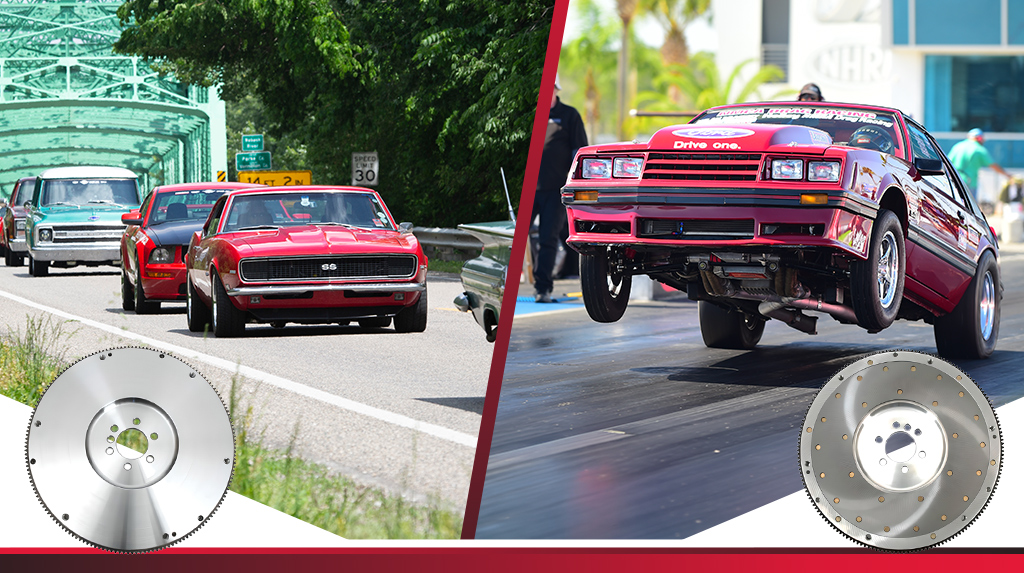
Choosing the right flywheel to go with the clutch for your TREMEC 5- or 6-speed manual transmission can be crucial to optimize performance and the driving experience. There are three types of materials commonly used for engine flywheels: aluminum and steel are the most common materials, with nodular iron being the third. We’re going to focus on aluminum and steel in this article.
Understanding Inertia
To understand the differences between steel and aluminum flywheels, it’s important to first understand inertia. This is the core difference in steel versus aluminum flywheels.
In simple terms, inertia is a property of matter that resists changes in motion. An object at rest tends to remain at rest, while an object in motion tends to continue moving at the same speed and in the same direction until acted upon by another force.
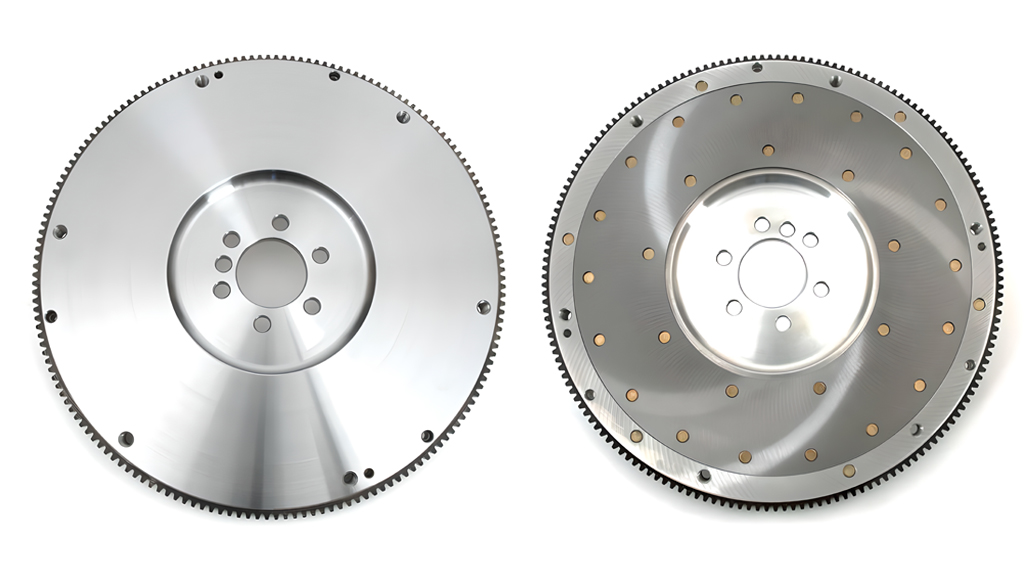
In a flywheel, inertia determines how much energy is required to increase engine RPM and how well the flywheel maintains RPM when the clutch is engaged. A flywheel with greater inertia stores more rotational energy, helping minimize RPM loss as the clutch transfers power through the transmission and drivetrain. A flywheel with less inertia requires less power to accelerate, but it also loses RPM more quickly under load.
Aluminum Flywheels: Lightweight Performance
Now replace the word “inertia” in the above paragraph with “weight.” The most obvious difference between aluminum and steel flywheels is weight. Because aluminum is significantly lighter than steel, it requires less engine power to spin and accelerate, reducing parasitic power loss. The lower rotating mass allows the engine to gain RPM more quickly, making aluminum flywheels an excellent choice for high-RPM engines and turbocharged applications where rapid engine acceleration helps build boost faster. Drivers also benefit from quicker acceleration through each gear.
However, because an aluminum flywheel stores less rotational energy, engine RPM drops more quickly when the clutch is engaged and the drivetrain begins absorbing power. In lightweight vehicles or dedicated competition applications, this isn’t necessarily a disadvantage. However, in heavier vehicles that require more energy to launch from a stop, the rapid RPM drop can pull the engine out of its powerband and create a bog during acceleration.

On the street, an aluminum flywheel typically requires more clutch finesse to prevent stalling. The increased clutch slipping needed during takeoff can also accelerate clutch disc wear. A heavier (aka steel) flywheel, makes smooth starts from a stop easier and also smooths shifts during normal driving.
Steel Flywheels: Greater Inertia and Improved Drivability
A comparable steel flywheel can weigh nearly twice as much as an aluminum version. For example, RAM Clutches lists comparable flywheels weighing approximately 16 pounds for aluminum and 33 pounds for steel.
While the heavier flywheels require more engine power to accelerate, it also provides substantially greater inertia. Once rotating, the additional stored energy helps maintain engine RPM when the clutch is released, reducing the RPM drop as the drivetrain comes under load.
The downside of a heavier flywheel is slower engine response. A steel flywheel won’t allow the engine to gain RPM as quickly, although the impact varies depending on the engine’s powerband and torque characteristics. Engines with less torque that produce most of their power at higher RPM generally feel this effect more than engines with abundant low-end torque.

For drag racing and many street/strip combinations, the added inertia can be an advantage. By helping maintain engine RPM during launch, a steel flywheel makes it easier to get a vehicle moving from a standstill without bogging the engine.
Safety Matters: Understanding SFI Ratings
Safety should always be a primary consideration when selecting a flywheel, particularly for performance and racing applications. The SFI Foundation establishes safety standards for a wide range of motorsports equipment, including flywheels, bellhousings, helmets, fire suits and roll cages. An SFI certification verifies that a component has been tested to withstand the stresses associated with its intended application.
Because a steel flywheel stores more rotational energy, it is especially important to choose a unit with the proper SFI rating for the engine’s horsepower, operating RPM and intended application.
Always choose a flywheel with the appropriate SFI rating for your engine’s horsepower, operating RPM and intended use. To learn more about SFI specifications and certification standards, visit the SFI Foundation website.

Which Flywheel Is Right for You?
There is no universally “better” flywheel. The right choice depends entirely on the vehicle, engine combination and intended use.
Generally speaking, heavier steel flywheels are a better choice for heavier cars or cars with engines favoring high-RPM horsepower over torque. Lighter aluminum flywheels are usually better suited for lightweight cars and engines having a lot of low-RPM torque, and aluminum flywheels are usually more suited for race vehicles rather than street.
Many TREMEC Elite Distributors offer complete clutch packages matched to specific TREMEC 5-speed and TREMEC 6-speed transmission applications, and manufacturers including ACT Clutches, Centerforce, McLeod Racing, RAM Clutches and SPEC Clutches offer flywheel and clutch combinations designed for a wide range of performance applications.
If you’re unsure which flywheel best fits your combination, consult one of these manufacturers or a TREMEC Elite Distributor. Selecting the proper flywheel and clutch combination will maximize performance while ensuring safe, reliable operation.